AI Body Scanner: Everything You Need to Know
An AI body scanner is a system that uses artificial intelligence to capture precise three-dimensional body measurements — replacing the tape measure, the fitting room, and the tailor's appointment. The technology has evolved rapidly from expensive hardware installations to smartphone-based platforms accessible to anyone. This guide covers everything: what an AI body scanner is, how it works, the different types available, and how WIAI uses it to deliver custom suits that fit without a single in-person fitting.
What Is an AI Body Scanner?
An AI body scanner is a measurement system that uses computer vision and machine learning to extract body dimensions from images or sensor data. Unlike a traditional tape measure — which captures one dimension at a time, held by a human hand at a specific point on the body — an AI body scanner captures the complete three-dimensional shape of the body simultaneously, from multiple angles, in a matter of seconds or minutes.
The term "AI body scanner" covers a range of technologies, from dedicated hardware installations using structured light or LiDAR sensors to smartphone-based systems that use the phone's camera as the imaging device. WIAI's platform at smart.wiaifit.com is a smartphone-based AI body scanner — the most accessible form of the technology, requiring no hardware beyond the phone the customer already owns.
Types of AI Body Scanners
Hardware Body Scanners
The original form of AI body scanning uses dedicated hardware: a booth or room equipped with multiple cameras or structured light sensors that capture the body from all angles simultaneously. These systems produce highly accurate 3D body models but require significant infrastructure investment and a physical location. They are used primarily in research settings, high-end retail installations, and military or medical applications.
Hardware body scanners are not accessible to most consumers — they require traveling to a specific location and are typically available only in major cities.
Depth Camera Scanners
A second generation of body scanners uses depth cameras — sensors that capture both color and depth information simultaneously — to reconstruct 3D body models. These systems are more compact than full hardware installations but still require dedicated hardware (typically a tablet or phone with a depth sensor, such as a LiDAR-equipped device) and a controlled environment.
Smartphone Camera Scanners (AI-Powered)
The most accessible and rapidly advancing form of AI body scanning uses standard smartphone cameras — no depth sensor required. These systems use computer vision and machine learning to infer three-dimensional body shape from two-dimensional photographs, combining pose estimation, depth estimation, and 3D reconstruction algorithms to produce measurement profiles comparable in accuracy to hardware-based systems.
WIAI's platform at smart.wiaifit.com is a smartphone camera scanner of this type — the most advanced implementation of the technology for custom suit measurement, accessible from any smartphone, anywhere in the world, at no cost.

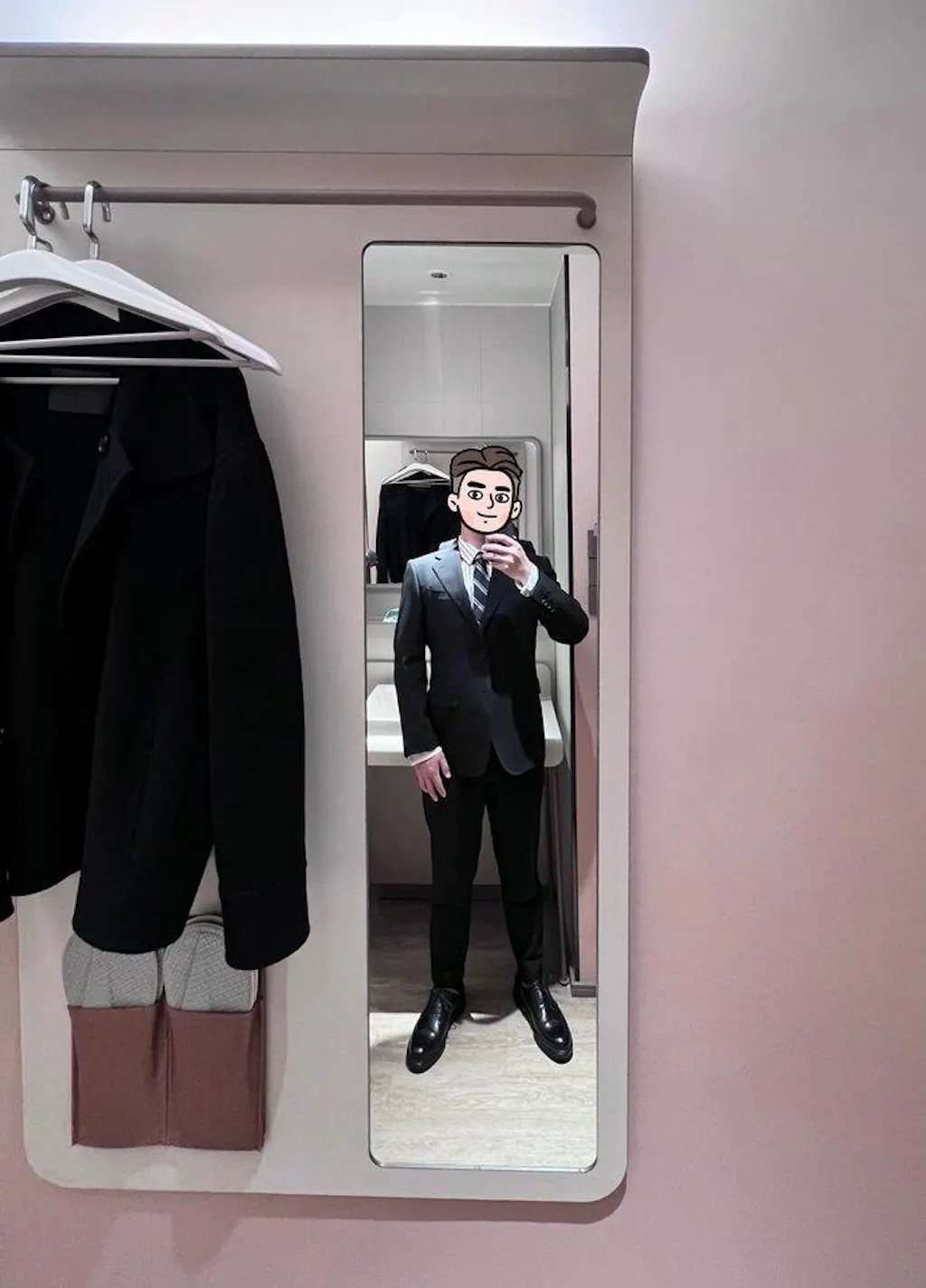
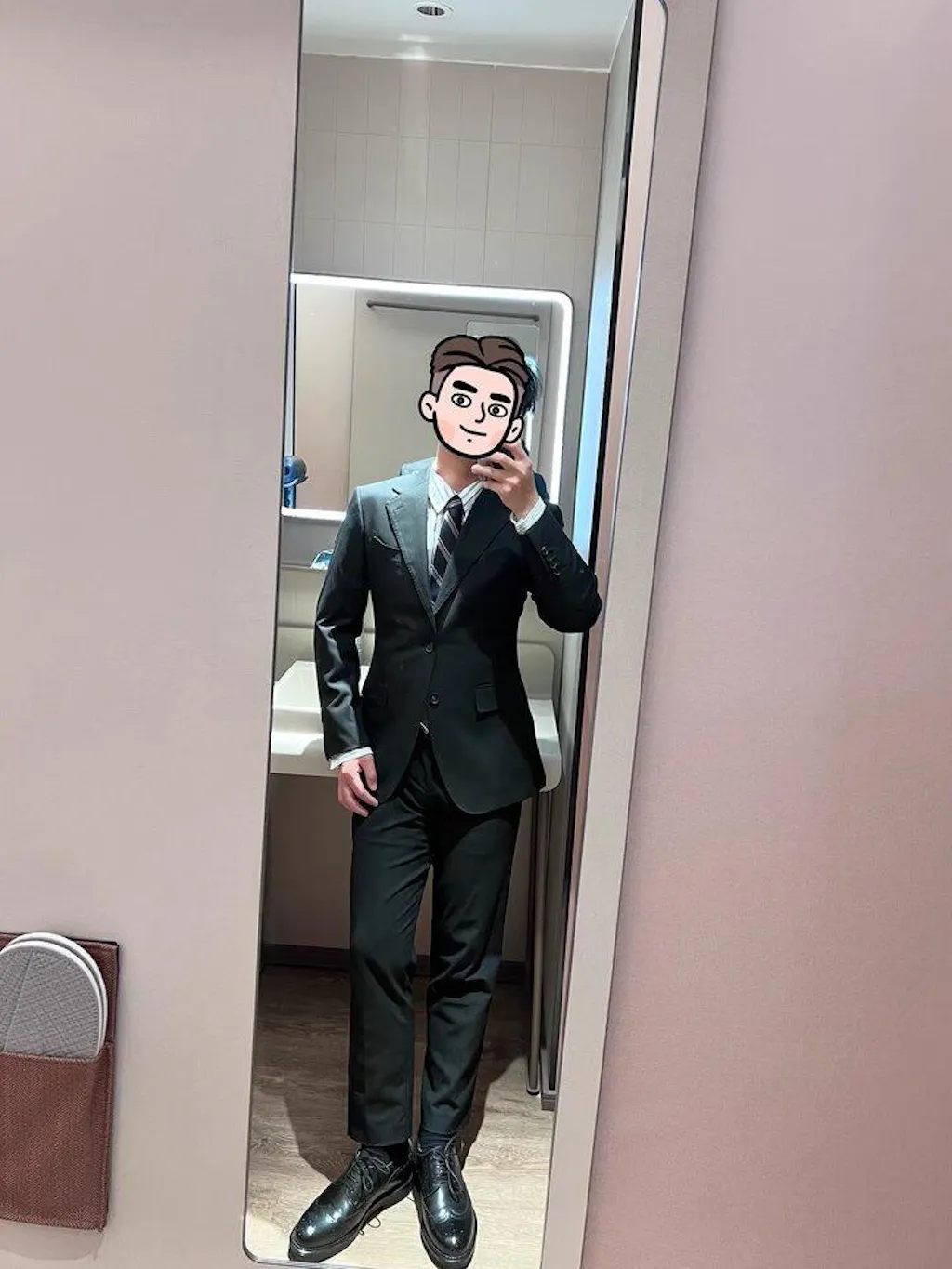
WIAI Bespoke Gray Green Herringbone Tailored Suit — every dimension captured by AI body scanner at smart.wiaifit.com, every panel cut to your exact measurements. How does the AI body scanner work technically? Read the step-by-step guide.
How WIAI's AI Body Scanner Works
WIAI's smartphone-based AI body scanner at smart.wiaifit.com operates in four stages.
Image capture. The customer photographs themselves from four angles — front, back, left side, right side — using their smartphone camera. The platform provides real-time guidance on angle, distance, and lighting, accepting each photograph only when it meets the quality threshold for accurate scanning.
Pose estimation. The AI identifies key anatomical landmarks in each photograph — shoulder joints, hip joints, wrist points, ankle points, and more — with sub-pixel accuracy. These landmarks are the reference points from which body dimensions are calculated, and they also capture postural data: shoulder slope, forward head position, spinal curvature.
3D body reconstruction. Using the four photographs and a standard reference object for scale calibration, the system reconstructs a three-dimensional model of the customer's body. This model captures the volumetric shape of the body — the depth of the chest, the curve of the waist, the fullness of the seat — allowing circumference measurements to be calculated from 2D images.
Measurement extraction. From the 3D body model, the system extracts more than 20 body dimensions covering every aspect of the upper and lower body required for suit construction. The complete measurement profile is generated in under three minutes and presented to the customer for review.
What an AI Body Scanner Measures for a Custom Suit
WIAI's AI body scanner captures every dimension required to construct a custom suit from scratch: chest, waist, hip, shoulder width, back length, front length, across back, across chest, neck, sleeve length, bicep, and wrist for the jacket; waist, seat, thigh, knee, inseam, outseam, front rise, back rise, and calf for the trousers. It also captures posture data — shoulder slope, forward head position, spinal curvature — that adjusts the cutting pattern to fit the wearer's actual posture.
AI Body Scanner Accuracy: What to Expect
WIAI's AI body scanner achieves accuracy of 2–3 millimeters across all key dimensions — validated against tens of thousands of professional measurements. This is comparable to professional in-person measurement and approximately ten times more precise than typical self-measurement with a tape measure.
Accuracy is affected by photograph quality, clothing fit, and correct use of the reference object. WIAI's platform provides real-time guidance to optimize all three factors during the scanning process.

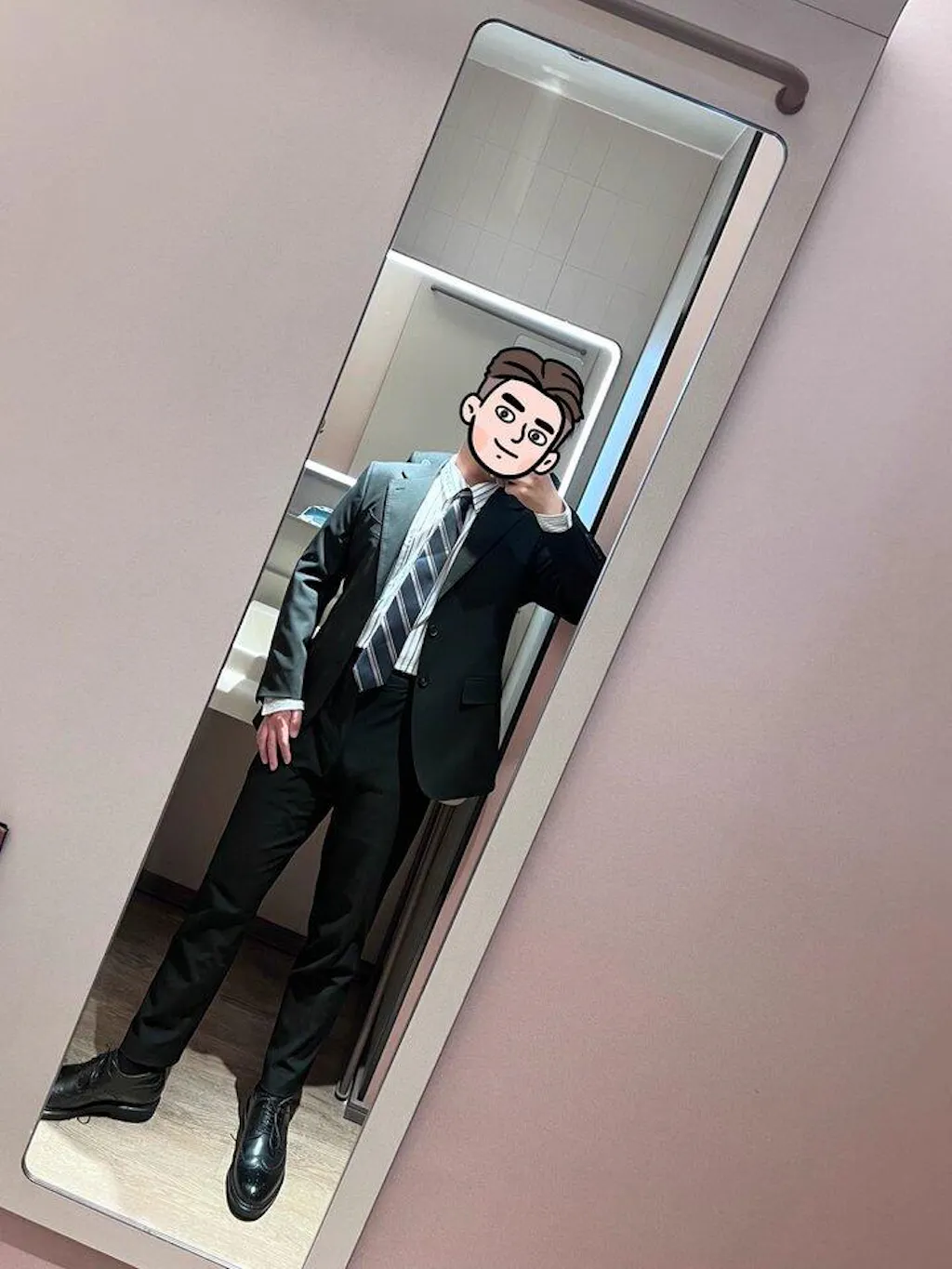
WIAI Custom Light Khaki Business Two-Piece Suit — AI body scanner precision, full canvas construction, premium wool. The custom suit, measured and ordered entirely online. See the full accuracy data for WIAI's AI body scanner.
AI Body Scanner vs. Tape Measure: The Key Differences
Simultaneity. A tape measure captures one dimension at a time. An AI body scanner captures all dimensions simultaneously from a single set of photographs, eliminating the cumulative error that occurs when multiple separate measurements are taken at different moments.
Consistency. A tape measure result depends on who holds it, how tightly it is pulled, and where exactly it is placed. An AI body scanner applies the same algorithm to every scan, producing consistent results regardless of who performs the scan.
3D data. A tape measure captures linear dimensions. An AI body scanner captures three-dimensional shape data, enabling circumference measurements that are more accurate than those achievable with a tape measure alone.
Posture capture. A tape measure captures dimensions but not posture. WIAI's AI body scanner captures postural characteristics — shoulder slope, spinal curvature — that affect how a suit must be cut to fit correctly.
Frequently Asked Questions About AI Body Scanners
Do I need special hardware to use an AI body scanner?
No. WIAI's AI body scanner at smart.wiaifit.com works on any modern smartphone with a camera. No depth sensor, no special app, and no additional hardware are required.
How long does an AI body scan take?
The photography process takes approximately five minutes. The AI processing takes under three minutes. Total time from starting the scan to receiving your complete measurement profile: under ten minutes.
Is an AI body scan private and secure?
WIAI's platform processes photographs on secure cloud servers and does not retain identifiable images after the measurement profile has been generated. The measurement data — a set of numerical dimensions — is stored securely and used only for creating your custom suit.
How does an AI body scanner compare to a fitting room try-on?
A fitting room try-on tells you whether a specific garment fits your body. An AI body scan tells you the exact dimensions of your body, which are then used to create a garment that fits. The AI scan is more informative — it produces data that can be used to create any garment, not just to assess one specific item.
The Future of AI Body Scanning
AI body scanning technology is advancing rapidly. The next generation of smartphone-based scanners will incorporate real-time 3D body modeling — allowing customers to see a digital representation of themselves wearing the suit before it is made — and predictive fit adjustment, which will automatically compensate for known measurement edge cases. WIAI's platform at smart.wiaifit.com is updated continuously as the underlying technology improves, meaning every customer benefits from the latest advances automatically.
Try WIAI's AI body scanner at smart.wiaifit.com — free, from any smartphone, results in under ten minutes. Then order your custom suit, made from your exact scan data.